
Digitalis purpurea
Family: Scrophulariaceae
Related Genera: Scrophularia, Selago, Verbascum
Names: Foxglove, Bloody Fingers, Common Foxglove, Dead Men's Bells, Fairy Caps, Fairy's Glove, Fairy Thimbles, Folk's Glove, Goblin Gloves, Lady's Glove, Our Lady's Gloves, Purple Foxglove, Witches' Gloves, Virgin's Glove, Fingerhut, Fuchskraut, Unserer-lieben-Frauen-Handschuh, Waldglöckchen, Waldschelle
General: Biennial, or short-lived perrenial, native to temperate Europe, naturalised in North America and other temperate regions. Develops a large basal rosette of hairy leaves in the first year, and a 1-2 m tall, flower bearing stem by the second year. The downwards pointing flowers form a large dense terminal cluster at the sun-exposed side of the stem. Their color is usually a bright purple, but can also be pink, red, white or yellow. They are bell or thimble shaped, heavily spotted on the inside and possess large, interlocking hairs that prevent smaller insects from gaining access to the flower's nectar. Only larger insects like bumble bees are able to climb deep into the flower head and gather nectar, whereby flower pollen sticks to their back and legs. First open the flowers at lower parts of the stem, which are innitially male, later turning female. So when the flowers at the upper and top parts have opened the flowers below are female, whilst the flowers on top are still male. Bumblebees, which approach always the bottom parts first and then move upwards, assure cross-fertilization. Flowering period begins in June/early summer and ends in September or October. Additional, smaller flowering stems may arise when the main stem has flowered ready. Each pollinated flower produces a seed pod which turns brown and bursts open, releasing hundreds of small light brown seeds.
History & Folklore: The scientific name digitalis is derived from latin digitus, meaning finger, which refers to the shape of the flowers, commonly perceived to resemble thimbles. The flowers have inspired human imagination for centuries. Fairies are believed to use them as a headdress and to have given them to foxes for wearing as gloves. Foxes could then break loudlessly into hen houses. The spotted patterns on the flowers were thus believed to be the finger prints of evil fairies. Foxes were also believed to use the flowers as "warning bells", signalling to each other when hunters were approaching. In Irland it was believed to avert the evil eye and the leaves are said to help break hexes. In Roman mythology, Flora showed Hera or Juno how to impregnate herself with no need of a man by touching a foxglove to her belly and her breasts. She either gave birth to Mars or Vulcan from this method, depending on the source. The plant is either attributed to be under the domain of Saturn or Venus. Dew collected from the flowers and leaves is used in ritual for communion with the fairy folks.
Strangely, the plant did not received much attention in the medical literature of the middle ages and antiquity. The British used it as an emetic and against tuberculosis until testings on turkeys showed a reduced size of heart, lung and liver in the animals. In 1775 the British physician William Withering began researching the effects of digitalis on the cardiacal system, after a herb women had drewn his attention towards the plant, and in 1785 released the famous treatise „An account of the Foxglove and its medical uses“. The french physician Drebeyne continued to research the effects of digitalis on the heart. In 1868 the chemist Nativelle isolated the active substance from the plant. During the following years other plants were found to contain similar, heart effecting substances, named digitalis glycosides, e.g. Convallaria majalis, Nerium oleander and Helleborus niger. (The only plant that had until then been known to have such effects in humans was Drimia maritima.) Today the main source for digitalis glycosides is D. lanata, the Woolly Foxglove.
The dutch painter Vincent van Gogh is said to have his epilepsy treated with Digitalis (Digoxin). He also portrayed his friend and doctor in charge with a Foxglove flower:
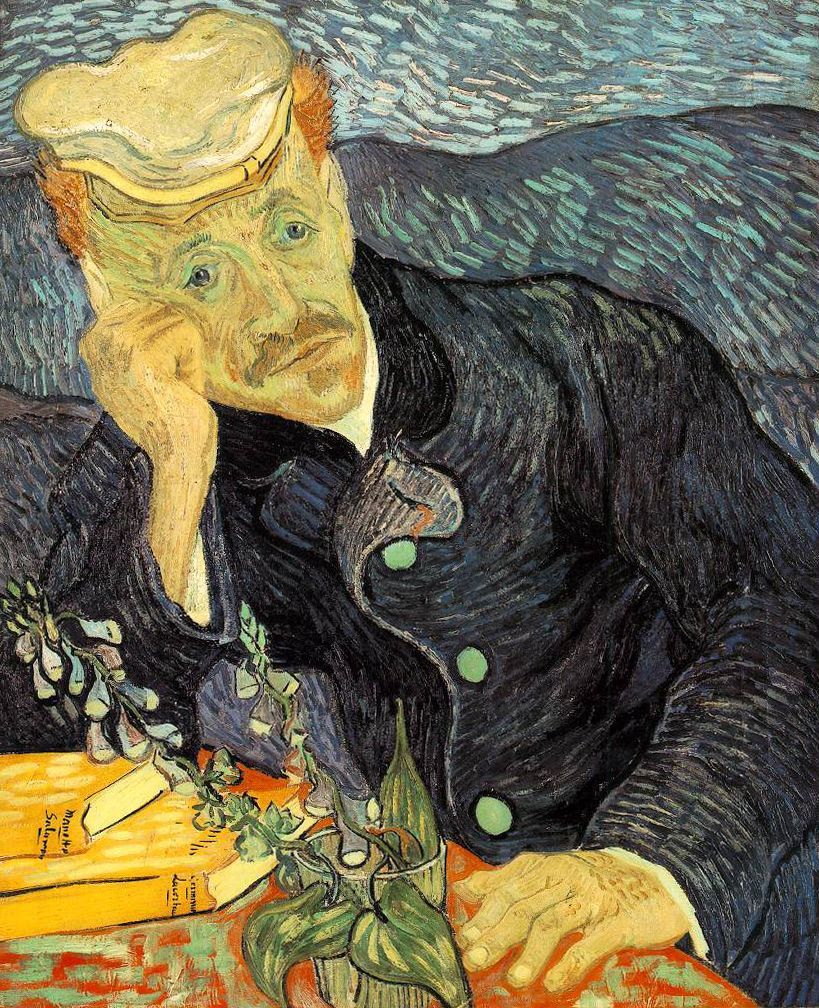 | |||
| Dr. Gachet, Vincent van Gogh, 1890, oil on canvas |
Medicinal & Toxicological: Most famously known for containing the cardiac glycosides Digoxin and Digitoxin, which are cardio tonics. At the right dose they cause the heart muscle to carry out stronger contractions, thus having a positive, strengthening effect on the heart and lowering the heart rate. They also act diuretic, increasing urine flow. Today digitalis glycosides are mostly applied for lowering the heart rate.
However, the interval from a non-effective to an over-dose is very small. Over-dose will cause a lowered pulse rate, nausea, vomiting, uncoordinated contractions of different parts of the heart and ultimately leading to cardiac arrest and death. Most poisonings with digitals are caused by medical error. Poisoning through ingestion occurs rather seldom, since the leaves have an acrid bitter taste. It would be treated with emetics and the stomache-pump. Antidotes are Atropine and nitrites.
Another compound found exclusively in the flowers and leaves of D. purpurea, D. orientalis and D. lanata is the steroid Digoxigenin (DIG), which has a wide range of application as an immunohistochemical marker.
New research conducted by Norwegian scientists points to possible anti-carcinogenic properties.
Digitalis has been used an anti-dote in Aconite poisoning.
Sowing & Growing: Needs light and moderate temperatures to germinate. Grows on cut-over land, at forest way sides and forest glades. Prefers fresh, lime-deficient, loose, humus-rich soil. Ground should be moist but well-drained and can be slightly acidic. Sow directly into the wild or cultivate in pots and plant them out when they have developed the first rosette of leaves. Plant at least 30-45 cm apart, in semi-shade. Cut flower stems before they produce seed to avoid self-propagation. They may sprout anew and flower again the following year. Mulching will prevent reseeding.
Sources: Wikipedia, Witchipedia,
Photos: Wiebke Rost

No comments:
Post a Comment