Thursday, November 21, 2013

Hyssop


Family: Lamiaceae

Tribus: Mentheae

Related genera: Dracocephalum, Elsholtzia, Lavendula, Lycopus, Melissa, Mentha, Monarda, Nepeta, Ocimum, Origanum, Rosmarinus, Salvia, Satureja, Thymus

The herb's magical potency lies in its cleansing powers. It is said to remove curses and 'uncross' the ill workings of other magicians. The dried herb is strewn or a herbal infusion is poured on a crossroad or used to wash the walls, windows and entrance of one's home. Likewise it is used in church for cleansing and blessing. Hyssop is mentioned in the old testament under the name esov or ezob. The herb originally referred to in the bible was one in the mint family and probably a type of Oregano. The Greec hyssopus of the Septuagint and the herb named Hyssop in modern times are not the same.

Hyssop is also a classic kitchen herb, a property it shares with many other herbs in the mint family. Tasting like a cross between Sage and Oregano, it is used to flavor various dishes. Its medicinal properties are mildly anti-inflammatory and expectorant, hence it was used as a cough remedy.

Growing Hyssop: Sow seeds on seeding compost and cover loosely with soil. Water regularly. Germination temperature: 20°C. Germination period: 1-2 weeks. Plant in a sunny, dry and warm place on loose, normal soil. Hyssop is an easy herb, which does not need much care. Water during drought, fertilize with a little compost soil. Bright blue flowers occure from the end of spring until late autumn and attract bees and other insects. There are also white and pink flowering variants. Hyssop grows into a small bush, 30-60 cm in height, with woody stems (similar to Lavender). A perennial, native to the Mediterranean Hyssop is completely hardy in continental regions. Cut back in spring. In Summer Hyssop can be pruned into an aromatic hedge to fence in flowerbeds. Harvest once at the end of spring and again by the beginning of fall.

Hyssopus officinalis 'Alba'

White Hyssop (Hyssopus officinalis 'Alba')

White and Blue Hyssop in the raised bed

Blue Hyssop (Hyssopus officinalis)
Sources: Wikipedia, Der Kräuter-Almanach, Outside Pride Non-GMO Seeds

Fotos © Teufelskunst/Wiebke Rost 

Sunday, February 24, 2013

Delphinium

Delphinium elatum

Family: Ranunculaceae

Related Genera: Aconitum, Anemone, Aquilegia, Helleborus, Pulsatilla, Ranunculus

Names: Candle Larkspur, Hoher Rittersporn

General: Most Delphinium garden hybrids and cultivars are derived from Delphinium elatum (syn: Delphinium × elatum), native to the Alps. Perrenial, grows on lime soils, on woodland clearings, as part of tall herbaceous vegetations, moist rock habitats and alongside rivers. Up to 1–2 m high stems, with tall spires or racemes of flowers in colors from deep and light blue to purple. There are also lilac, light pink and white flowering variants. They are mostly grown as ornamental plants, for traditional and native plant gardens. Flowering from June to August, they attract butterflies and other pollinators. Each flower develops a follicle, which contains numerous small black seeds.

The juice of the flowers, mixed with alum, gives a blue ink.

Delphinium cultivar

Sowing & Growing: The seeds have a short term viability. Use fresh seeds. Best is if they are sown directly after you gathered them from the plant. Sowing temperature: 22-24°C. Cover with soil. 
Grows on lime soils, on woodland clearings, as part of tall herbaceous vegetations, moist rock habitats and alongside rivers. Plant 50 cm apart, in full sun. Water regularly, but do not overwater. Soil should be evenly moist, humus rich and well-drained. PH should be neutral and not acidic (eventually add lime). Hardy, no winter-protection needed. Prone to mildew: cut back and discard all infested parts. May need staking from strong winds, or plant at the fence or infront of a stonewall. Remove flowerheads after flowering, unless seeds are wanted.

History & Folklore: Delphinium elatum has been cultivated since at least 1578 and constitutes the main parental unit for most garden cultivars. The name Delphinium, from Greek delphis, a dolphin, is inspired by the shape of the nectary.

Delphinium was one of the herbs used on the feast of St. John, and as such, warded off lightning. In Transylvania, one was used to keep witches from the stables. Another superstition helt that drinking the seed of larkspur was thought to help against the stings of scorpions, and that other poisonous animals could not move when covered by the herb. Sacred to Saint Odile of Alsace, a patroness of good eyesight, in popular medicine Delphinium was used against eye diseases.

The seeds have been used against parasites, especially lice and their nits in the hair. A tincture is used against asthma and dropsy.

Medicinal & Toxicological: All parts of the plant contain various diterpenoid alkaloids, especially methyllycaconitine (MLA). MLA has "curare-like" properties and plays a roll in livestock poisoning. An overdose can lead to death through complete motor paralysis and respiratory arrest.

In small amounts, extracts of the plant have been used in herbal medicine.

All parts of these plants are considered toxic to humans, causing severe digestive discomfort if ingested, and also skin irritation.

Biochemical:

Methyllycaconitine
Sources: Wikipedia,

Thursday, February 21, 2013

Tobacco

Nicotiana tabacum

Family: Solanaceae

Related Genera: Atropa, Capsicum, Datura, Hyoscyamus, Mandragora, Scopolia, Solanum

Names: Common Tobacco,Virginia Tobacco, Virginischer Tabak

General: Annual species, ,native to the tropical and sub-tropical Americans and now commercially cultivated worldwide. Other varieties are cultivated as ornamental plants or grow as a weed. Up to 2.5 m high with large green leaves and long trumpet shaped white-pinkish flowers. All parts are sticky, covered with short viscid-glandular hairs, which exude a yellow secretion containing nicotine.

Nicotine is produced in the root. All parts of the plant contain nicotine, except for the seeds. Older plants have higher concentrations of nicotine, which is dominant in the leaves (ca. 64%). The concentration varies, depending on the species, age, type of land, culture and weathers conditions. 

History & Folklore: In their first voyage to the New World, Christopher Columbus and his expedition were introduced to a plant whose smoke was called tobacco by the natives of Hispaniola.
In 1559 Jean Nicot, French ambassador to Portugal, sent it as a 'wonder medicine' to the court of Catherine de' Medici. In 1586 the botanist Jaques Dalechamps gave the plant the name of Herba nicotiana, which was also adopted by Linné. The plant was first grown as an ornamental, then considered a panacea and lastly became common to consume as a snuff and tobacco.

The leaf extract became a popular pesticide and in 1851 occured the first account of poison murder with tobacco leaf extract: Belgian count Hippolyte Visart de Bocarmé had poisoned his brother-in-law out of greed.

The plant has a long history of use in Ethnomedicine worldwide.

Medicinal & Toxicological: Contains various alkaloids, foremost the potent parasympathomimetic Nicotine. Because nicotine acts as an antiherbivore chemical, tobacco and nicotine analogs are used as insecticides. The use of nicotine insecticide (waste from the tobacco industry) has decreased since the 1980ies in favor of other substances, which are less harmful to mammals. Nicotine sulfate sold for use as a pesticide is labeled "DANGER," indicating that it is highly toxic. After 1 January 2014, this pesticide will not be available for sale any longer.

In smaller doses (an average cigarette yields about 1 mg of absorbed nicotine), nicotine acts as a stimulant in mammals, while high amounts (30–60 mg) can be fatal. Nicotine is extremely addictive and nicotine addiction is considered one of the hardest to break, similar to addiction to heroin and cocaine. Nicotine also enhances addiction to other substances, such as cocaine.

Nicotine's mood-altering effects are both stimulant and relaxing, depending on the mode of consumption.

Sowing & Growing: Sensitive to temperature, air, ground humidity and the type of land. Temperatures of 20–30 °C (68–86 °F) are best for adequate growth; an atmospheric humidity of 80 to 85% and soil without a high level of nitrogen are also optimal.

Curing & Aging: After tobacco is harvested, it is cured (dried), and then aged to improve its flavor. There are four common methods of curing tobacco: air curing, fire curing, flue curing, and sun curing. The curing method used depends on the type of tobacco and its intended use.
  • Air-cured tobacco is sheltered from wind and sun in a well-ventilated barn, where it air dries for six to eight weeks. Air-cured tobacco is low in sugar, which gives the tobacco smoke a light, sweet flavor, and high in nicotine. Cigar and burley tobaccos are air cured. 
  • In fire curing, smoke from a low-burning fire on the barn floor permeates the leaves. This gives the leaves a distinctive smoky aroma and flavor. Fire curing takes three to ten weeks and produces a tobacco low in sugar and high in nicotine. Pipe tobacco, chewing tobacco, and snuff are fire cured. 
  • Flue-cured tobacco is kept in an enclosed barn heated by flues (pipes) of hot air, but the tobacco is not directly exposed to smoke. This method produces cigarette tobacco that is high in sugar and has medium to high levels of nicotine. It is the fastest method of curing, requiring about a week. Virginia tobacco that has been flue cured is also called bright tobacco, because flue curing turns its leaves gold, orange, or yellow. 
  • Sun-cured tobacco dries uncovered in the sun. This method is used in Greece, Turkey, and other Mediterranean countries to produce oriental tobacco. Sun-cured tobacco is low in sugar and nicotine and is used in cigarettes.
Once the tobacco is cured, workers tie it into small bundles of about 20 leaves, called hands, or use a machine to make large blocks, called bales. The hands or bales are carefully aged for one to three years to improve flavor and reduce bitterness.

Sources: Wikipedia, Aussaat and Anbau, How to Grow Tobacco,

Tuesday, February 12, 2013

Scopolia

Scopolia carniolica

Family: Solanaceae

Related Genera: Atropa, Capsicum, Datura, Hyoscyamus, Mandragora, Nicotiana, Solanum

Names: Henbane Bell, Bijeli bun, Krainer Tollkraut, Glockenbilsenkraut

General: Perennial, poisonous plant in the Solanaceae family, native to South-Eastern Europe from lowlands to mountain zones, found foremost on wet soils in beech forests. The flowers are colored a dark brownish purple on the outside and brown-green to yellow on the inside. They are bell-shaped, looking somewhat similar to those of Belladonna, but larger and hanging downwards. Flowering time is in April and May. They produce a yellow-green fruit, which is surrounded by a lampion-like calyx, containing around 30-50 seeds. The fruits have been mistaken for those of Nicandra physaloides.

History & Folklore: Henbane Bells have been cultivated since the 18th century. The name Scopolia was given to the plant by Carl von Linné in honor of Italian botanist Giovanni Antonio Scopoli, whereas carniolica is refering to its native region. The plant may have been used in 'witch' salves and ointments, similar as Belladonna, Henbane or Mandrake, used as an aphrodisiac and as a psycho-active agent or entheogen. It has also been added to beer, in philtres and used elsewhere for enhancing intoxication.

Scopolia carniolica is the symbol of the Slovenian Society of Anaesthesiology and Intensive Care Medicine.

Medicinal & Toxicological: Contains several alkaloids, like most species in the Solanaceae family. The main alkaloid is S-Hyoscyamine (about half the amount as in Atropa belladonna). Highest amount of active substances is during the flowering period and ripening of the fruits. Besides this, the roots are said to contain the greatest amount of active agents. the rhizome is gathered in autumn, cut at one side and dried.

Poisoning can cause nausea, vomiting, blushes, mydriasis, hallucinations, spasms, impaired speech and vision disorders. An overdose may ultimately lead to death through respiratory paralysis.

Sowing & Growing: Sow flat on seed sowing compost, which has been mixed with sand. Make sure the soil stays moist but not wet. Don't allow for seedlings to fall dry. Germinate in containers, in a well-lit place. Sow early in spring. Plant outdoors in autumn, once the plant has died back. Like A . belldonna they develop a strong rhizome. They are hardy and will sprout new early in spring, flowering early, sometimes when it is still snowing. Protect from slugs.

Other Species: Japanese Belladonna (Scopolia japonica), Himalayan Belladonna (Scopolia tangutica), Scopolia lutescens, Korean Scopolia parviflora

Sources: Wikipedia, Botanikus, Tollkraut und Hexenprozesse, Flora Croatica, Plants for a Future, Preparation of the rhizome

Photo by Wiebke Rost © 2013

Thursday, February 7, 2013

Lily of the Valley

Convallaria majalis

Family: Asparagaceae

Subfamily: Nolinoideae (= former Ruscaceae)

Related Genera: Polygonatum, Ruscus

Names: Lily Constancy, Ladder-to-heaven, Male Lily, Mary's Tears, May lily, May bells, Muguet, Our Ladie's Tears

General: Perennial, woodland flowering plant, native to the Northern hemisphere in Asia, Europe and the USA, forming large colonies through rhizomes. They bear white, sometimes also pink, sweet fragrant flowers, typically in May, with bright red fruits riping from June to September, which may contain 2-3 seeds. Propagation from seed is possible, though not easy. Also, the plants are self-sterile and colonies springing from one single clone will not set seed at all.

History & Folklore: Commonly viewed as a herald of spring, life and Easter. In the language of flowers it signals the return of happiness. It was sacred to Pagan goddess Ēostre /Ostara, and was representative of her purity and humility. In Christianity it is also known as Our Ladie's Tears and Mary's Tears. Sacred to the virgin mother Mary, the flower was believed to have sprung from the tears she shed during the crucifixion. In the bible is mentioned another flower by the name Lily of the Valleys, which may have been a possible origin for the name now attributed to C. majalis. In another legend the flower is believed to have sprung from the tears shed by Eve when driven with Adam from the Garden of Eden. In religious paintings it commonly represents humility and the Second Coming of Christ. It stands also for the power in men to envision a better world. The flower is also sacred to Frankish St. Leonard of Noblac, who battled a dragon.

The scientific name majalis means "belonging to the month of May". In astrological magic the plant is traditionally associated with Mercury, possibly because the Greek Maia, goddess and name-sake for the month of may, was the mother of Hermes, to which Mercury was the Roman equivalent.

Medicinal & Toxicological: C. majalis contains 38 known cardiac glycosides, such as convallamarin, which has digitalis-like effects, and is applied as a cardio tonic and diuretic. All parts of the plant are poisonous. Ingestion of only small amounts can cause gastric pain, nausea, vomiting, diarrhoea and a lowered heart rate in humans. Poisoning through ingestion is treated with emetics and the stomache-pump. Atropine  and nitrites are given as antidote.

C. majalis also contains bourgeonal, an aromatic aldehyde, which stimulates olfactory senses in males and activates attracts mammal sperm. It is used commercially in perfume industry.

The plant contains further saponines, which are little understood up to date. Saponines are known mostly for their piscicidal usage amongst indigenous people.

Sowing & Growing: Difficult to grow from seed. Cold Germinator. Best use fresh seeds, directly taken from the ripe fruits. Sow ca. 1 cm deep, into seed sowing compost, which has been mixed with sand and loam. The soil should be rich, loose and well drained. It can be mixed with 50% loam. Use small containers that you place directly in the ground or on a seed bench in a green-house, which is not temperature regulated during the winter. If left to germinate under natural conditions, sow directly in September/October or by the end of winter. Otherwise place your sowing containers first at 18-22°C.  After 2-4 weeks you can move them outdoors in the winter or in the fridge and keep them at -4-4°C for at least 1 month. If kept in the fridge it might be better to not sow in soil but use a substrate and paper towels. After 4-6 weeks you should change the surrounding temperature to 5-12°C. Or simply move sowing containers outdoors in spring. In nature they will germinate stimulated by the rise of temperatures, sunlight and snow melt. Germination time will vary, depending on the conditions and age of seeds, from a couple of weeks to 1 year. Young plants may not like to be transplanted, so make sure you sow them at least 5 cm apart from each other, so that they have enough space to grow. If grown in a container use some fertilizer.

Once grown succesfully you can plant them out in the first year, preferably in September. Choose a place in semi-shade, where morning and evening sun reaches, with rich, well drained soil. They spread easily through rhizomes and soon develop large colonies, unless they do not like the place you planted them. Growing them from seed takes a lot of time. They will not flower before the 3rd, sometimes only by the 5th year. They will flower only once.

Sources: Wikipedia, Henriette's Herbal, Additional sources to be added

Photos: Wiebke Rost

Foxglove


Digitalis purpurea

Family: Scrophulariaceae

Related Genera: Scrophularia, Selago, Verbascum

Names: Foxglove, Bloody Fingers, Common Foxglove, Dead Men's Bells, Fairy Caps, Fairy's Glove, Fairy Thimbles, Folk's Glove, Goblin Gloves, Lady's Glove, Our Lady's Gloves, Purple Foxglove, Witches' Gloves, Virgin's Glove, Fingerhut, Fuchskraut, Unserer-lieben-Frauen-Handschuh, Waldglöckchen, Waldschelle

General: Biennial, or short-lived perrenial, native to temperate Europe, naturalised in North America and other temperate regions. Develops a large basal rosette of hairy leaves in the first year, and a 1-2 m tall, flower bearing stem by the second year. The downwards pointing flowers form a large dense terminal cluster at the sun-exposed side of the stem. Their color is usually a bright purple, but can also be pink, red, white or yellow. They are bell or thimble shaped, heavily spotted on the inside and possess large, interlocking hairs that prevent smaller insects from gaining access to the flower's nectar. Only larger insects like bumble bees are able to climb deep into the flower head and gather nectar, whereby flower pollen sticks to their back and legs. First open the flowers at lower parts of the stem, which are innitially male, later turning female. So when the flowers at the upper and top parts have opened the flowers below are female, whilst the flowers on top are still male. Bumblebees, which approach always the bottom parts first and then move upwards, assure cross-fertilization. Flowering period begins in June/early summer and ends in September or October. Additional, smaller flowering stems may arise when the main stem has flowered ready. Each pollinated flower produces a seed pod which turns brown and bursts open, releasing hundreds of small light brown seeds.

History & Folklore: The scientific name digitalis is derived from latin digitus, meaning finger, which refers to the shape of the flowers, commonly perceived to resemble thimbles. The flowers have inspired human imagination for centuries. Fairies are believed to use them as a headdress and to have given them to foxes for wearing as gloves. Foxes could then break loudlessly into hen houses. The spotted patterns on the flowers were thus believed to be the finger prints of evil fairies. Foxes were also believed to use the flowers as "warning bells", signalling to each other when hunters were approaching. In Irland it was believed to avert the evil eye and the leaves are said to help break hexes. In Roman mythology, Flora showed Hera or Juno how to impregnate herself with no need of a man by touching a foxglove to her belly and her breasts. She either gave birth to Mars or Vulcan from this method, depending on the source. The plant is either attributed to be under the domain of Saturn or Venus. Dew collected from the flowers and leaves is used in ritual for communion with the fairy folks.

Strangely, the plant did not received much attention in the medical literature of the middle ages and antiquity. The British used it as an emetic and against tuberculosis until testings on turkeys showed a reduced size of heart, lung and liver in the animals. In 1775 the British physician William Withering began researching the effects of digitalis on the cardiacal system, after a herb women had drewn his attention towards the plant, and in 1785 released the famous treatise „An account of the Foxglove and its medical uses“. The french physician Drebeyne continued to research the effects of digitalis on the heart. In 1868 the chemist Nativelle isolated the active substance from the plant. During the following years other plants were found to contain similar, heart effecting substances, named digitalis glycosides, e.g. Convallaria majalis, Nerium oleander and Helleborus niger. (The only plant that had until then been known to have such effects in humans was Drimia maritima.) Today the main source for digitalis glycosides is D. lanata, the Woolly Foxglove.

The dutch painter Vincent van Gogh is said to have his epilepsy treated with Digitalis (Digoxin). He also portrayed his friend and doctor in charge with a Foxglove flower:
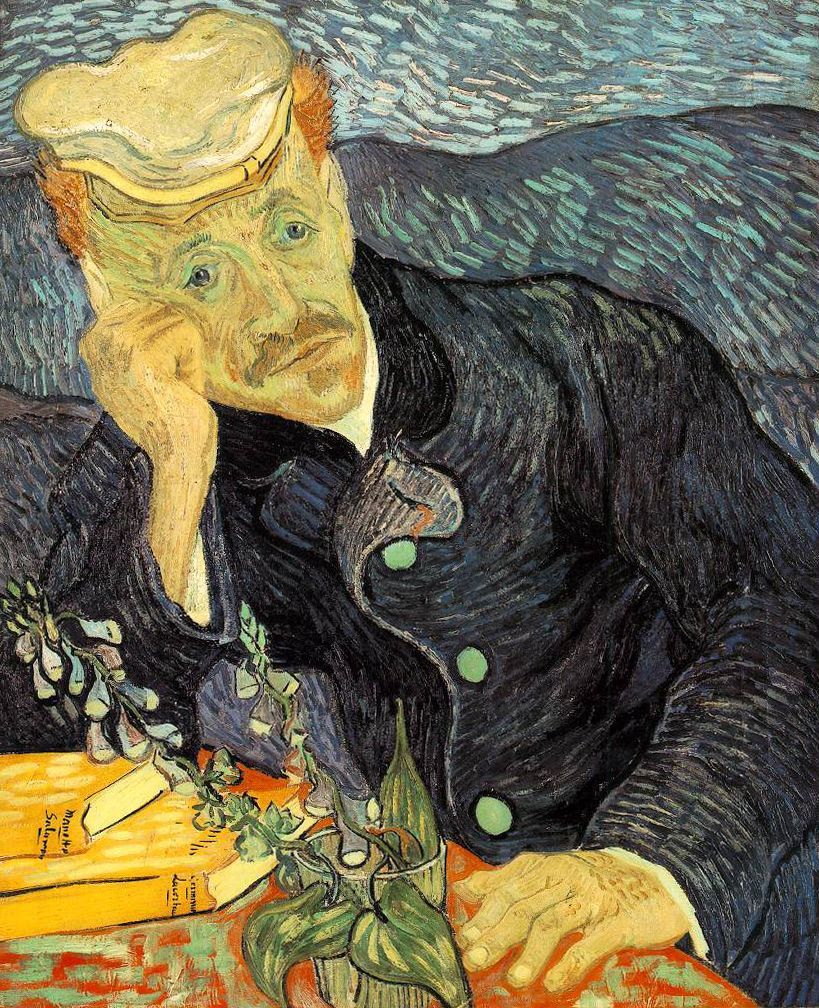

Dr. Gachet, Vincent van Gogh, 1890, oil on canvas


Medicinal & Toxicological: Most famously known for containing the cardiac glycosides Digoxin and Digitoxin, which are cardio tonics. At the right dose they cause the heart muscle to carry out stronger contractions, thus having a positive, strengthening effect on the heart and lowering the heart rate. They also act diuretic, increasing urine flow. Today digitalis glycosides are mostly applied for lowering the heart rate.

However, the interval from a non-effective to an over-dose is very small. Over-dose will cause a lowered pulse rate, nausea, vomiting, uncoordinated contractions of different parts of the heart and ultimately leading to cardiac arrest and death. Most poisonings with digitals are caused by medical error. Poisoning through ingestion occurs rather seldom, since the leaves have an acrid bitter taste. It would be treated with emetics and the stomache-pump. Antidotes are Atropine and nitrites.

Another compound found exclusively in the flowers and leaves of D. purpurea, D. orientalis and D. lanata is the steroid Digoxigenin (DIG), which has a wide range of application as an immunohistochemical marker.

New research conducted by Norwegian scientists points to possible anti-carcinogenic properties.

Digitalis has been used an anti-dote in Aconite poisoning.

Sowing & Growing: Needs light and moderate temperatures to germinate. Grows on cut-over land, at forest way sides and forest glades. Prefers fresh, lime-deficient, loose, humus-rich soil. Ground should be moist but well-drained and can be slightly acidic. Sow directly into the wild or cultivate in pots and plant them out when they have developed the first rosette of leaves. Plant at least 30-45 cm apart, in semi-shade. Cut flower stems before they produce seed to avoid self-propagation. They may sprout anew and flower again the following year. Mulching will prevent reseeding.

Sources: Wikipedia, Witchipedia,

Photos: Wiebke Rost

Mullein


Species: Verbascum densiflorum

Family: Scrophulariaceae

Related Genera: Digitalis, Scrophularia, Selago

Names: Mullein, Aaron’s Rod, Candelaria, Candlewick Plant, Flannelplant, Graveyard Torches, Hag’s Taper, Our Ladie’s Flannel, Shepherd’s Clubs, Velvet, Witch’s Candle, Woolly, Königskerze, Himmelsbrand, Marienkerze, Wetterkerze, Wollblume, Wollkraut, Brennkraut

General: The biennial herb is native to Europe and Asia. It was imported into the United States around 1700 as a fish poison and has since naturalized. It grows almost anywhere in full sunlight and spreads easy via seed. The seeds can remain dormant and viable in the soil for several years until germination. It is sometimes considered a weed. Natural enemies are weevils and slugs.

The flowers attract butterflies, honey bees and other visitors. They are boiled and used to dye clothes and hair. Extracts of the leaves are used as a pesticide in the garden and against cockroaches. It is also said to prevent the growth of mosquito larvae. The dried leaves and stems were common to dip in resin or pitch and used as torches or as lamp wicks. Mullein powder was thrown into fish waters; fish would rise to the surface in need of oxygen and could be easier collected.

Mullein has been known as a healing herb since antiquity.

Folklore: The name mullein probably derives from the Latin mollis, soft. The Latin species name Verbascum is  derived from Latin– ‘ver’ meaning ‘spring’ and ‘barbascum' = ‘bearded plant’.


The leaves soaked in salpetre solution were dried and placed in the fire on Midsummer. Torches made from Mullein stalks were also part of Samhain celebrations. Mullein is believed to ward off evils spirits and black magic; during the 1930ies Mullein became also called ‘Graveyard Dirt’ as it was used as a substitute for real graveyard dirt.

Wearing Mullein as a charm is said to ward off wild animals. Mullein placed under the pillow protects from nightmares (or attracts good dreams). In India it is hung over doors for protection from bad spirits.

Mullein is named as one ingredient of the Anglo-Saxon Nine-Herb Charm

Odysseus may have used Mullein to protect himself from the enchantments of the witch Circe

Mullein is a symbol of long life

Mullein in associated with the planets mercury, jupiter and saturn, and the element fire.

Cowslip and Evening Primrose have also been called Petty Mullein and are attributed similar properties.

Medicinal & Toxiological: Mullein extracts act expectorant and show mild sedative properties. It is commonly used in teas for colds. Care should be taken as not ingest any of the tiny hairs, which can be irritating to the mucuous mebranes. Mullein tea combined with milk is also used to treat diarrhea; a sweetened infusion of the flowers is also used to treat cholics. If smoked it relieves chronic cough and asthma (asthma cigarettes). It has also been used as a tobacco substitute to quit smoking. Poultices with the leaves are used to trreat hemorrhoids. The leaves infused in olive oil are a cure for frost bite and burns. The warmed oil acts anti-bacterial and is used to treat ear infections. Mullein tincture is used to treat migraines and chronic inner-ear disorders.

The flowers contain glycyrrhizin compounds which act anti-bacterial and potentially anti-tumoral.

Mullein seeds contain rotenone which is used as a pesticide, insecticide, and as a non-selective piscicide (fish killer); it is also used to reduce parasitic mites on chickens and other fowl.

The hair covering the entire plant is irritating to the skin and should not be inhaled or ingested.

Sources: Wikipedia English, Wikipedia German, Mullein is not Graveyard Dirt, Herb of the Season, Verbascum Nomenclature, A Modern Herbal,